
One source of truth for every department
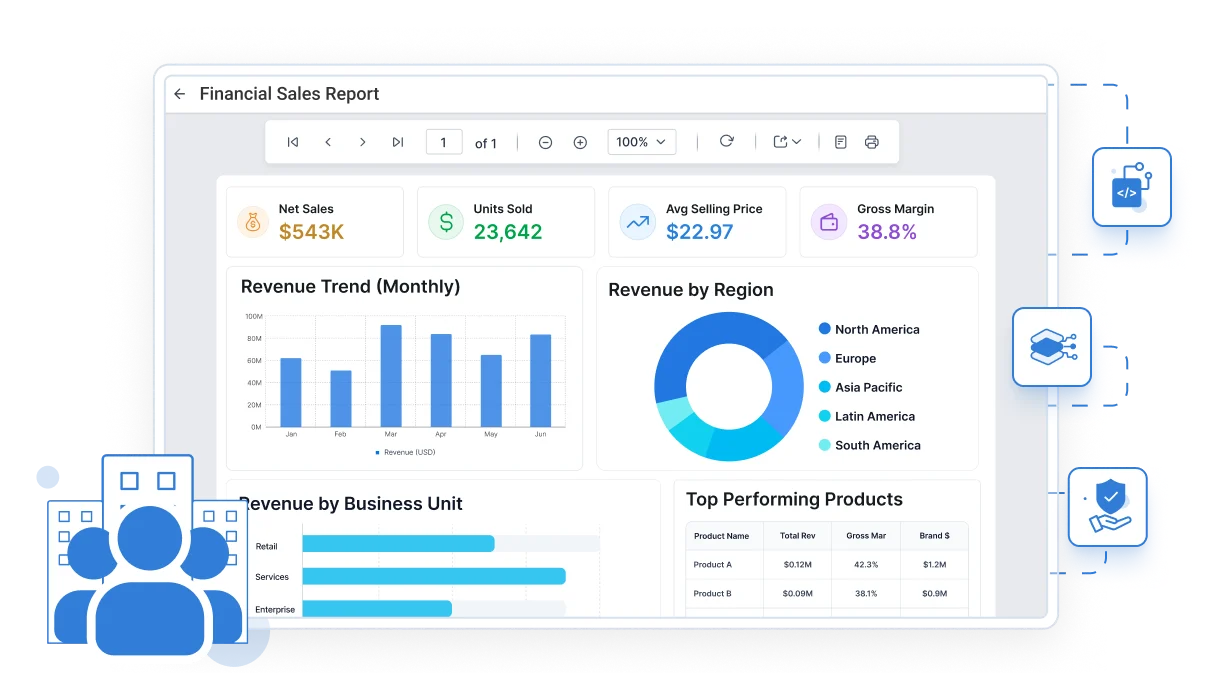
Bold Reports consolidates siloed, legacy reporting tools into one secure, governed platform so every department builds pixel-perfect, paginated reports from the same shared data.
-
Define datasets, centrally: Every team reports on the same trusted numbers.
-
Pixel-perfect, paginated output: Exportable reports to PDF, Excel, and more.
-
Deploy on-prem, cloud, or containers: Sits on your existing data, no replace.
Trusted by IT and finance teams at enterprises across 40+ industries.
1 Unified Platform
Governed platform for every department
4+ Systems Merged
Legacy tools consolidated onto one system
Live in Weeks
To connect existing data sources, not months
100% Audit-Ready
Central access logs, versioning, and trails
When every team reports differently, no one trusts the numbers
Your data lives everywhere and that’s exactly the problem. As departments and business units grow, reporting fragments faster than IT can contain it: different tools, different definitions, different delivery schedules.
The result – a fractured view of the business that slows decisions, inflates cost, and creates real compliance exposure.
No single source of truth
Finance, sales, and operations each run their own tools, so the same metric tells three different stories. Every meeting starts by arguing about whose numbers are right.
Rising maintenance cost
Every legacy or inherited system carries its own licenses, servers, and specialists. Overlapping tools quietly drain IT budget and headcount while value stays flat.
Slow, manual delivery
Analysts spend days stitching spreadsheets together by hand, so reports arrive late and out of date. Teams wait on decisions that should be available on demand.
Compliance and audit gaps
Inconsistent definitions and undocumented report logic make every audit a fire drill. Without a governed, traceable layer, "where did this number come from?" has no clean answer.
Bring every department’s reporting under one governed platform
Bold Reports connects to the data sources your teams already use SQL and NoSQL databases, cloud warehouses, web services, and files. You consolidate reporting on top of your existing stack, so business units keep autonomy while IT keeps central control.

Connect once, report everywhere
Unify data from across departments and systems into shared, reusable datasets so a metric means the same thing in every report, ensuring consistency across the reporting platform.

Self-service within guardrails
Empower business users to build and explore reports while IT enforces permissions, branding, and data standards centrally, ensuring governance without slowing report creation efforts.

Pixel-perfect delivery, automated
Replace manual report runs with scheduled distribution, live reports, and embedded reports delivering pixel-perfect, paginated reports that export PDF, Excel, and Word for stakeholders and auditors alike.
Where enterprise teams centralize reporting
The situations that bring teams to Bold Reports each one a version of the same problem: too many reporting tools, not enough trust in the numbers.
Consolidate after acquisitions
Every acquired entity brings its own reporting stack. Bring them onto one governed platform instead of maintaining five disconnected tools and five versions of the truth.
Retire aging or end-of-life reporting tools
Standardize departments still running legacy SSRS, Crystal Reports, or Jaspersoft deployments onto one supported platform on your timeline, without a big-bang migration.
Standardize the month-end close
Give finance one set of shared dataset definitions so every entity’s close reports reconcile no more chasing why three spreadsheets show three numbers for faster financial reporting.
Compliance-ready reporting
Access logs, report versioning, and audit trails provide the controls regulated organizations need to simplify compliance management.
Self-service without losing control
Let business units build and schedule their own reports inside permissions and data standards that IT sets centrally autonomy for the team, governance for the org.
Value your whole leadership team can align on
Consolidating reporting affects every part of the business differently. Here's what changes for each team once everyone works from the same platform.
For CIOs & IT Directors
- Retire redundant legacy tools and reduce total cost of ownership.
- Centralize governance, access control, and data standards.
- Deploy on-premises, in the cloud, or embedded, on your terms.
For Finance Reporting
- Report from consistent, defined metrics across every entity.
- Cut month-end reporting cycles with automated distribution.
- Strengthen audit readiness with centralized report governance.
For Business Unit Heads
- Get self-service reports without waiting on a central queue.
- See live performance dashboards tailored to your unit.
- Trust that your numbers reconcile with the rest of the business.
For Data Teams
- Build once with reusable datasets, then serve many teams.
- Reduce ad hoc requests with scheduled and embedded delivery.
- Standardize how reports are built, styled, and secured.
Built for the way enterprises actually deploy reporting
When you're comparing platforms, these are the four things that separate a real enterprise fit from a point solution stretched too far.

Flexible deployment
Run Bold Reports on-premises, in your private cloud, in containers, or embedded directly inside your applications. Meeting your security and data-residency requirements, including air-gapped environments.

Broad data connectivity
Connect to a wide range of relational, big data, cloud, and web-service sources, so centralization never means leaving data behind.

Enterprise-grade governance
Role-based access, tenant isolation, and centralized administration keep a consolidated platform secure and support the controls your compliance frameworks require, at scale.

Consolidated, predictable cost
Replacing multiple point tools with one platform simplifies licensing and lowers the ongoing maintenance burden on IT.
One platform vs. a stack of point solutions
Here's how centralizing reporting on Bold Reports stacks up against stitching together multiple legacy or point tools.
| Feature | Legacy / point solutions | Bold Reports |
|---|---|---|
| Report output | Output tied to each tool; teams juggle a document tool and a dashboard tool | Pixel-perfect paginated documents and dashboards from one platform, exportable to PDF, Excel, and Word |
| Multi-department scalability | Separate tools per team; scaling means more silos | Scales across all business units on one platform |
| Compliance & audit | Manual, inconsistent, and hard to trace | Central audit trails, versioning, and access logs |
| Implementation time | Months of custom integration per tool | Weeks: connects to existing data sources |
| Total cost of ownership | Stacked licenses plus specialized admins | One platform, consolidated licensing |
| Governance | Fragmented, per-tool permissions | Centralized role-based control |
-
Looking for the full product capabilities: multi-tenant, embedded reporting, and developer SDKs? Explore Bold Reports enterprise reporting →
Proven at enterprise scale
J&J
Schneider
Bridgestone
Siemens
Verizon
HP
Fidelity
Intel
“Bold Reports is easy to use, enabling both teams and business users to modify reports confidently. Setup is quick and smooth. It integrates well with SQL Server, Microsoft Fabric, and other tools, reduces infrastructure complexity, and works reliably for recurring reports.
Brad M, enterprise customer
Questions enterprise teams ask before consolidating
Both, Bold Reports produces pixel-perfect, paginated reports like invoices, statements, financial and regulatory documents that need exact layout for print and PDF, alongside interactive dashboards. A single governed platform covers operational documents and analytics, so teams don’t need one tool for each.
No, Bold Reports sits on top of your existing data sources and connects to them directly. You consolidate reporting without migrating or replacing your underlying systems.
Centralized, governed reporting gives you consistent metric definitions, role-based access, and traceable report logic reducing the inconsistencies that create audit gaps.
Yes, Bold Reports supports on-premises, cloud, and embedded deployment so you can meet your security, compliance, and data-residency requirements.
It depends on the format. Bold Reports is RDL/RDLC-native, so existing SSRS reports can be brought over in their native format rather than rebuilt from scratch. Crystal Reports (.rpt) files use a proprietary format and are not imported one-to-one those reports are recreated in Bold Reports through a guided, assisted process, not a one-click converter. In every case, your underlying data sources stay in place.
Yes, business units build and manage their own reports within permissions and standards set centrally by IT balancing self-service with governance.
Replacing multiple legacy tools with a single platform lowers licensing, infrastructure, and specialist-maintenance costs and reduces the operational overhead of supporting several disconnected systems.
See what one reporting platform can do for your whole organization
See how Bold Reports unifies your departments in a live walkthrough or take the enterprise evaluation guide to your team.
Talk to a solutions architect about your reporting estate, no obligation.